What is a Breach of Duty?
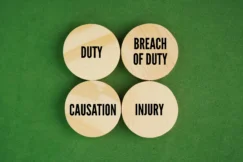 A breach of duty occurs when a person or business fails to exercise the level of care the law requires, thereby putting others at risk. It is the second of four elements you must prove in a negligence claim: duty, breach, causation, and damages.
If you were hurt in a car crash, on someone’s property, or by a careless business, proving a breach of duty is the heart of your case. Without it, there is no negligence claim, no matter how serious your injuries are.
Duty Comes First: What the Law Expects of People
Before anyone can breach a duty, a duty has to exist. The law imposes a duty of care in almost every daily interaction, even though most people never think about it. Common examples include:
- Drivers must follow traffic laws and stay alert behind the wheel
- Property owners must keep their premises reasonably safe for visitors
- Doctors and nurses must treat patients according to accepted medical standards
- Businesses must fix or warn about hazards they know exist
- Manufacturers must sell products that are safe when used as intended
Once a duty exists, the question becomes whether the person met it. That is where breach comes in.
The Reasonable Person Standard
Courts in Missouri and Kansas measure most conduct against the “reasonable person” standard. The question is simple: would a reasonably careful person have acted this way in the same situation?
A driver who checks a text message and rear-ends you failed that test. A grocery store that leaves a spill on the floor for an hour failed too. The standard does not demand perfection. It demands ordinary, sensible caution.
Some situations raise the bar. A surgeon is held to the standard of a reasonably skilled surgeon, not an average person. A trucking company must follow federal safety regulations that go beyond those that apply to everyday drivers. When a defendant has specialized training or operates in a regulated industry, the duty of care increases accordingly.
How a Breach of Duty Is Proven
In personal injury cases, breach is proven with evidence, not assumptions. Depending on your case, that evidence might include:
- Police and incident reports documenting what happened
- Photos and video from the scene, traffic cameras, or security footage
- Witness statements from people who saw the conduct
- Cell phone records showing a driver was distracted
- Maintenance logs, inspection records, or internal emails
- Expert testimony explaining the standard of care and how it was violated
In some cases, breaking a safety law is itself strong evidence of breach. If a driver runs a red light in violation of Missouri Revised Statutes § 304.281 or K.S.A. § 8-1508 and causes a crash, the violation helps establish that the driver failed to use reasonable care.
Breach Alone Is Not Enough
Proving that someone acted carelessly is only part of the job. You also have to show causation, meaning the breach actually caused your injuries, and damages, meaning you suffered real losses like medical bills, lost income, or pain and suffering.
For example, if a store left a spill on the floor but you slipped on an unrelated patch of ice outside, the store’s breach did not cause your injury. The four elements work together, and insurance companies attack each one.
Causation itself has two parts. First, your injury would not have happened without the breach. Second, the harm was a foreseeable result of the careless conduct, not a freak coincidence. Damages must also be documented, not just claimed. Medical records, pay stubs, repair estimates, and testimony about how your life has changed all turn your losses into numbers a jury can award. The stronger your proof on each element, the harder it is for the other party to deny.
Fault does not have to be one-sided for you to recover, but how much you keep depends heavily on which side of the state line your case falls on. Missouri Revised Statutes § 537.765 lets you recover compensation even if you carried most of the blame, simply shrinking your award by your share of fault. K.S.A. § 60-258a draws a harder line in Kansas: once your fault reaches 50%, you recover nothing at all.
Get Answers About Your Case
If you believe someone’s carelessness caused your injuries, you do not have to figure out the legal elements on your own. Our team investigates what happened, gathers evidence proving a breach of duty, and handles the insurance company so you can focus on healing.
Consultations are free, and you pay nothing unless we win. Call Wendt Law Firm at (816) 531-4415 or contact us online to find out whether you have a case.
$100M+
Pharmaceutical
$10.3M
Motor Vehicle
Accident
$6M
Sexual Abuse
Case
Schedule Your Free Case Evaluation
” * ” Indicates Required Fields

© Copyright 2026 Wendt Law Firm P.C.. All rights reserved.
